Need 24/7 Service? Call for Emergency Repairs Call:
Troubleshooting Guide — Why Garage Doors Fail in Late February in Central Ohio (And How to Catch Problems Early)
Updated: February 9, 2026
Quick answer: Repeated late-February freeze–thaw swings, road salt and lingering moisture increase friction, corrode small parts, and overload aging springs and openers. Catch problems early by running a 10-step inspection: listen for new noises, test balance, check springs and cables visually, wipe salt residue, and lubricate moving parts with a silicone product. Call a local pro for any visible spring damage or safety-trigger items below. weather.gov
Here’s the truth — why late February is prime failure season
Late February routinely mixes sub-freezing nights with daytime thawing in Central Ohio. Those cycles let melting slush and road brine enter tracks and hinge pockets, then refreeze overnight. That repeated freeze–thaw puts short, sharp stresses on springs, bearings, rollers, cables, and weather seals. The county applies road salt and brine to keep roads safe; salt tracked into garages speeds metal corrosion at connection points. These exact weather and salt conditions create a small-but-real spike in emergency garage door calls during late winter. weather.gov
What stressors act on garage doors during late February?
Freeze–thaw cycles and temperature swing mechanics
Metal parts contract in cold and expand when temperatures rise. Repeated cycles introduce micro-movement at bolts, brackets, and spring anchor points. weather.gov
Salt, slush and moisture-driven corrosion
Road salt and brine get tracked into the garage bottom and left in pockets of the track and hardware. Salt accelerates surface pitting and bearing failure. See local de-icing guidance from the Franklin County Engineer.
Cold-thickened lubricants, stiff rollers, and added load
Many lubricants stiffen in low temperatures, increasing friction and transferring stress to springs and the opener motor. Use silicone or white-lithium products rated for low temperatures per Clopay guidance.
Most common failure modes you’ll see in late February
Claim → Evidence → Implication
Broken or weakened torsion/extension springs
Claim: Springs break more often as temperatures swing. Clopay
Evidence: Cold increases required torque; older springs near end-of-life fail under these extra loads. overheaddoorcompanyofhuntsville.com
Implication: A broken spring can make the door collapse and damage the opener; never attempt DIY spring replacement.
Stuck or jumping rollers and misaligned tracks
Claim: Freeze-thaw plus salt debris causes rollers to bind or jump tracks. Garage.com
Evidence: Accumulated slush or frozen hardened lubricant makes smooth travel impossible. Clopay
Implication: Track damage increases opener strain and may lead to uneven door sagging.
Corroded cables, fasteners and weather seals
Claim: Salt-driven corrosion weakens cables and fasteners faster than normal. irvinelocalgaragedoor.com
Evidence: Small parts rust first; internal cable strand corrosion is often invisible until a failure. andersondoorcompany.com
Implication: Corroded cables can snap under tension; fasteners may pull out of the door panels or track brackets.
Opener motor strain and premature trip/reverse
Added friction, binding rollers or a heavy door from spring weakness cause the opener to work harder and trip safety limits or reverse unexpectedly. Check settings and avoid forcing the drive.
Table — Likely cause → early sign → immediate action
| Likely cause | Early sign | Immediate action |
|---|---|---|
| Broken/weak spring | loud “pop,” door suddenly heavy or will not stay open | Stop using opener; keep door closed; call a pro. Clopay |
| Stiff rollers / frozen lubricant | grinding, jerking, slow travel | Clean track, apply silicone lube; test; call tech if noise continues. Clopay |
| Salt corrosion on hardware | white residue, pitting, loose bolts | Wipe salt off, apply protectant, replace badly corroded parts. Raynor |
| Misaligned track | door rubs or light is visible at edges | Do not force operation; tighten mounting hardware; call pro for re-alignment. Garage.com |
How to inspect your garage door this week — 10-step early-detection checklist
- Safety first: Disconnect the opener (pull the red emergency release) before any manual tests. Clopay
- Visual spring check: Look for gaps in coils or heavy rust. If you see a gap, stop—do not try to lift the door. Clopay
- Manual balance test: With the opener disconnected, lift the door halfway. It should hold near waist height. If it slams or is heavy, springs or cables need service. Clopay
- Listen on operation: Run the door and listen for new bangs, grinding, or rattles. Note exactly when the sound happens. Clopay
- Inspect rollers and tracks: Wipe out debris. Look for pitting, frozen lubricant, or roller wobble. Replace steel rollers if bearings feel rough. Garage.com
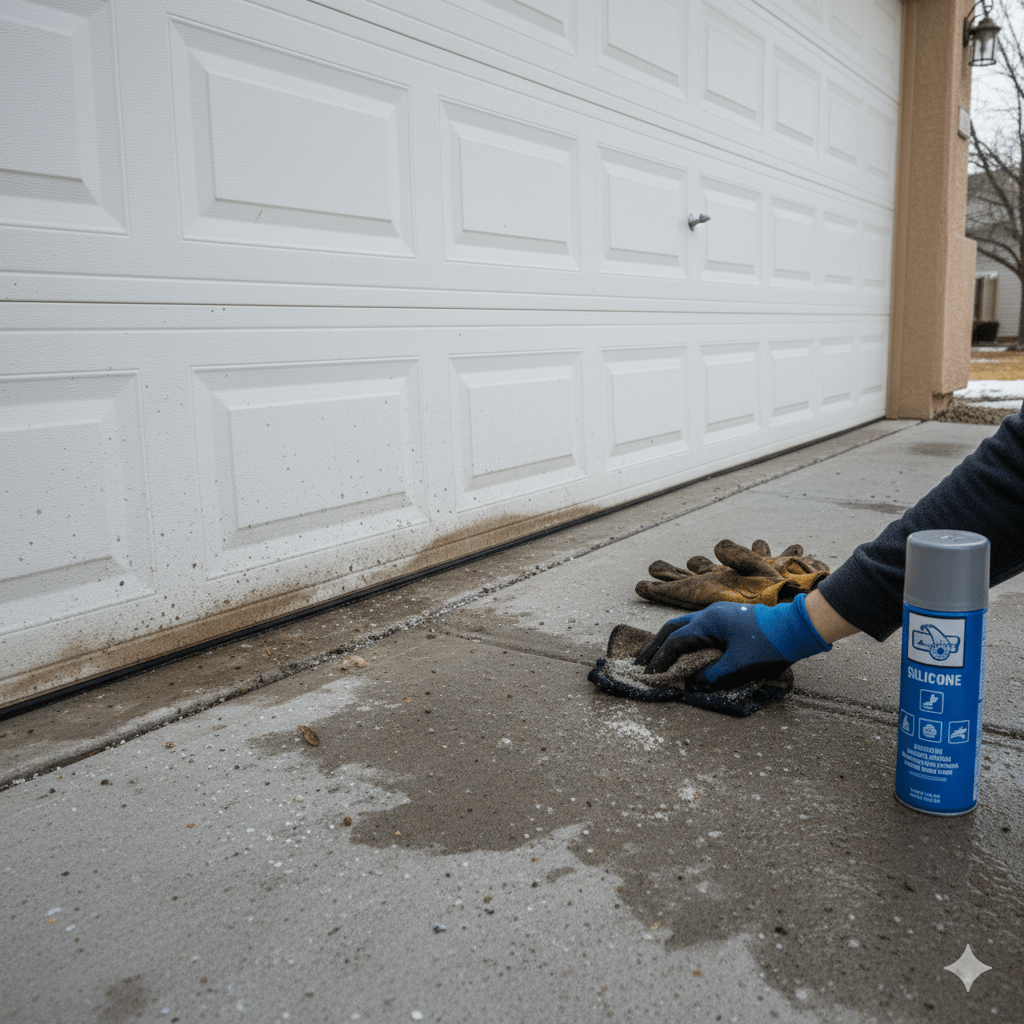
- Wipe salt: Use a damp cloth and water to remove road salt at the bottom of the door and on lower tracks. Dry thoroughly. metroparks.net
- Check cables/fasteners: Look for fraying, rust, or loose bolts. Any visible fray or snapped wire means stop using the door. andersondoorcompany.com
- Lubricate moving parts: Use a silicone or white-lithium garage-door lubricant on springs, hinges, and bearings. Avoid WD‑40. Re-lubricate every 3–6 months. Clopay
- Test opener settings: Make sure limit and force settings are correct; if the opener struggles or trips, don’t force operation. Clopay
- Document and schedule: Write down observed issues; if any safety-trigger items appear, book a local inspection the same week.
Quick fixes you can do safely today
- Clean and dry the bottom track and door edges after a thaw; remove salt residue. metroparks.net
- Apply silicone-based lubricant to springs, hinges, and bearings. Do not lubricate nylon roller tires. Clopay
- Tighten loose bolts on brackets with a socket or wrench. Avoid adjusting spring tension. Clopay
What NOT to do (common homeowner mistakes)
- Do not try to replace or adjust torsion springs. They hold dangerous tension. Call a trained technician. Clopay
- Don’t use oil-based lubricants like household oil or WD‑40 long-term; they attract grit and gum up in cold. Clopay
- Don’t pry a frozen bottom seal with force; it can bend tracks and panels.
When to call a local pro (safety triggers and likely repair costs)
- Visible gap in a torsion spring coil or any snapped spring. Clopay
- Frayed or visibly corroded lift cables. andersondoorcompany.com
- Track bending, torn panels, or door that falls when opened manually. Garage.com
- Opener motor smoking, burning smell, or repeated motor trip on otherwise balanced door. Clopay
Typical cost expectations (local-market ranges)
- Spring replacement: $150–$350 per spring (single-door typical range). The Spruce
- Tune-up / lubrication: $50–$150 depending on provider and door count. The Spruce
- Track or major hardware replacement: prices vary; alignment and small part fixes are usually lower than full track or door panel replacement. Get written estimates.
A homeowner micro-story (humanized insight)
Last late February I helped a neighbor whose door suddenly wouldn’t stay open. We followed steps 1–3 in this checklist. The owner had ignored slow grinding for weeks. The house’s bottom track held a thin crust of brine and the torsion spring showed early pitting. A quick local service call that afternoon replaced the spring and cleaned the track — much cheaper and faster than an emergency tow-away and garage-door replacement.
Summary: prevention plan for February and early spring
1) Inspect once after a warm day following a freeze event. 2) Wipe salt and lubricate moving parts with a silicone product every 3 months (and after heavy salt exposure). 3) Call a local certified technician immediately for any visible spring gap, frayed cable, or falling door. weather.gov
Sources and next steps
- NOAA / National Weather Service climate normals (1991–2020)
- Franklin County Engineer — Snow Fighters and de-icing details
- Clopay — lubrication, cold-weather troubleshooting, maintenance guides
- Raynor — salt-damage and lubrication guidance
- Garage.com — track and roller troubleshooting
- The Spruce — spring replacement costs and lifecycle
If your door shows any of these signs, a local inspection can prevent a costly emergency repair.